Deepfakes have moved from a technical curiosity to a practical fraud tool. The core risk is
not only that media can be fabricated, but that trust, evidence, and identity can be attacked
at scale.
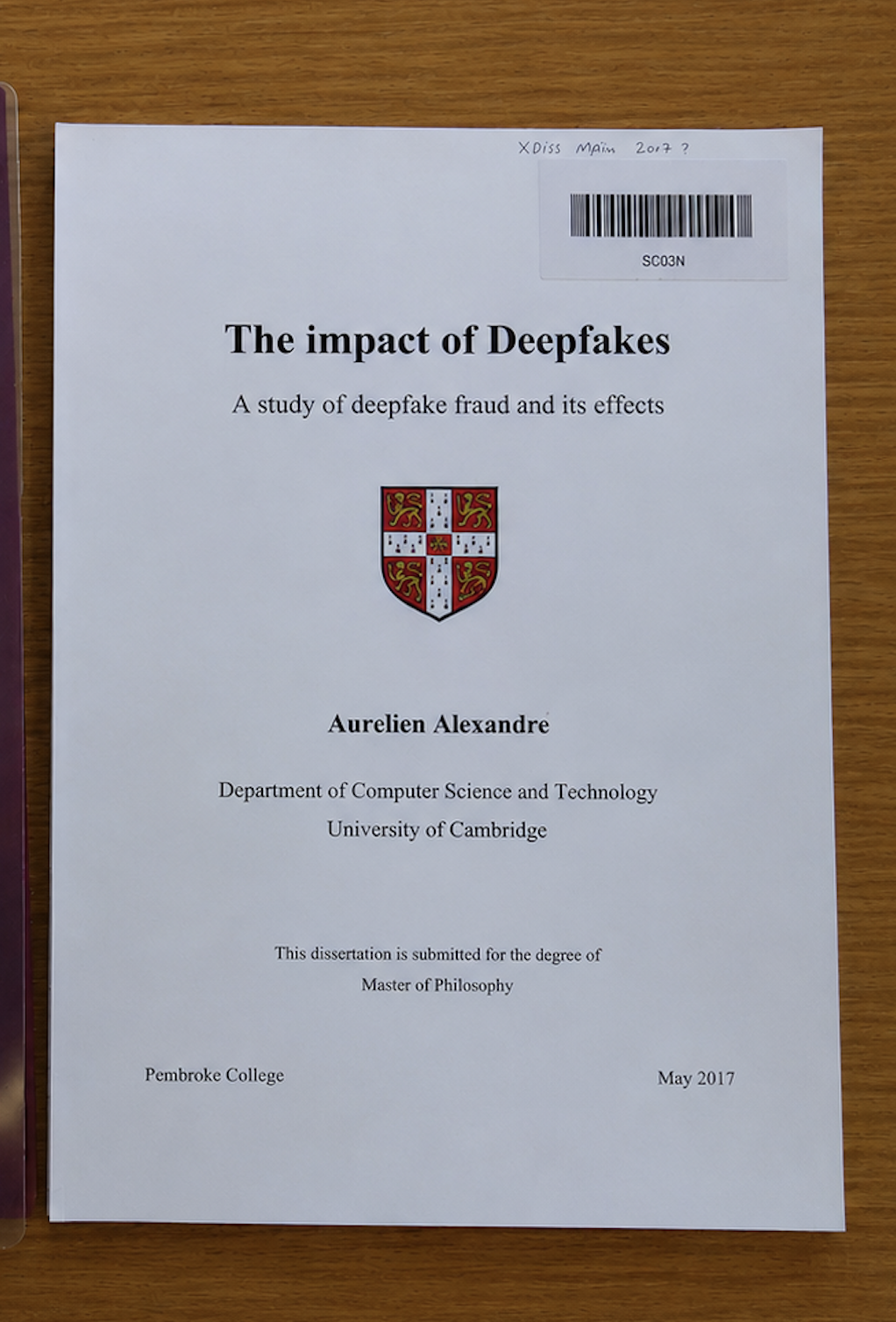
Thesis: The impact of Deepfakes, a study of deepfake fraud and its effects.
Thesis viewer
Read the thesis manuscript
Browse The impact of Deepfakes through its abstract, chapters, conclusion, and
selected references.
AbstractPage i
Abstract
This dissertation examines the impact of deepfakes on fraud, institutional trust, and
evidentiary confidence. It argues that deepfakes should not be understood simply as
manipulated videos, but as a class of synthetic identity technologies that change the
economics of deception. By reducing the cost of impersonation and increasing the apparent
intimacy of fraudulent communication, deepfakes alter how victims interpret urgency,
authority, and authenticity.
The study combines technical analysis of generative models with case-based examination of
voice cloning, executive impersonation, non-consensual synthetic imagery, and political
disinformation. It finds that the most consequential harms arise not from perfect fakes,
but from plausible fakes deployed in moments where verification is inconvenient. The work
therefore proposes a shift from content-only detection to process-based resilience:
provenance, out-of-band verification, payment controls, and institutional literacy.
The term deepfake describes media produced or altered by machine-learning systems
so that a person appears to say or do something that did not occur. Early public discussion
focused on face-swapping videos, but the contemporary threat landscape is wider: cloned
voices, real-time video avatars, synthetic identification documents, and generated images
now form a connected ecology of synthetic identity.
The central claim of this thesis is that deepfakes matter because they detach identity from
reliable human presence. A voice on the telephone, a face in a video call, or an image
attached to a profile was once treated as weak but useful evidence of personhood. Deepfakes
exploit that habit. They do not need to survive forensic analysis indefinitely; they need
only to be credible long enough for money to move, consent to be extracted, or a reputation
to be damaged.
Three research questions guide the analysis. First, how do generative systems make
impersonation cheaper and more scalable? Second, why are deepfakes effective in fraud
contexts even when visual imperfections remain? Third, what forms of governance and
organizational design reduce harm without treating detection as a complete solution?
Deepfake harm is rarely a purely technical failure. It is a failure of social process under
conditions of uncertainty.
Chapter 2Pages 13-31
2. Technical Background
Deepfakes are enabled by generative models that learn statistical regularities from large
datasets and then synthesize new outputs. Autoencoders, generative adversarial networks,
diffusion models, neural vocoders, and transformer-based architectures all contribute to
the present deepfake ecosystem. Although these systems differ architecturally, their social
effect is similar: they transform biometric cues into editable media.
Face-based systems map expressions, pose, and lighting from a source actor to a target
identity. Voice systems learn phonetic and timbral features from a sample of speech, then
generate new utterances in the target voice. Real-time systems combine these techniques
with low-latency rendering, allowing impersonation during live calls. The threshold for
abuse has fallen because models are increasingly available as consumer tools rather than
specialist research artifacts.
Detection research typically searches for artifacts: irregular eye movement, inconsistent
shadows, compression traces, temporal flicker, or spectral anomalies in audio. However,
detection is adversarial. A classifier trained on yesterday's artifacts may fail against
tomorrow's generator. For this reason, detection should be treated as one layer in a
broader system rather than the foundation of trust.
Generation lowers the cost of creating persuasive identity signals.
Distribution platforms lower the cost of targeting and amplification.
Verification gaps convert plausible media into financial or reputational harm.
Chapter 3Pages 32-58
3. Fraud, Identity, and Trust
Fraud depends on a believable story. Deepfakes strengthen that story by adding sensory
evidence to social engineering. A fraudulent email can be ignored; a voice that resembles
a colleague, parent, or senior executive can produce urgency before deliberation begins.
The psychological mechanism is not perfect deception but pressured interpretation.
Business email compromise illustrates the shift. Traditional attacks rely on compromised
accounts, spoofed domains, and procedural ambiguity. Synthetic media adds a performative
layer: the attacker can simulate the authority figure whose instruction is being invoked.
In a video meeting, multiple synthetic participants may create the illusion of consensus,
making refusal feel socially costly.
This chapter treats deepfake fraud as an attack on institutional routine. Payment approvals,
password resets, hiring checks, and customer onboarding all use identity shortcuts because
organizations need speed. Deepfakes weaponize those shortcuts. A resilient response must
therefore redesign the moments at which trust is granted.
Fraud vector
Deepfake role
Defensive control
Executive payment request
Voice or video authority cue
Dual approval and callback
Account recovery
Synthetic selfie or voice
Device history and risk scoring
Public disinformation
Fabricated event evidence
Provenance and rapid correction
Chapter 4Pages 59-82
4. Governance and Evidence
Governance of deepfakes is difficult because synthetic media has legitimate uses:
accessibility, dubbing, satire, film production, privacy-preserving avatars, and education.
A useful framework must distinguish consent-based synthesis from deceptive impersonation
and must account for context. The same technique may be harmless in a labelled film scene
and harmful in an unlabelled political advert or payment instruction.
Legal and regulatory responses increasingly focus on impersonation, non-consensual
intimate imagery, election interference, and disclosure. Yet law is slow compared with
model diffusion. Platforms and institutions therefore carry practical responsibility:
labelling synthetic content, preserving provenance metadata, authenticating official media,
and offering rapid appeal mechanisms for victims.
The evidentiary problem is two-sided. False media can be believed, but true media can also
be dismissed as fake. This second problem, sometimes called the liar's dividend, means that
deepfakes weaken the background assumption that recordings settle disputes. Provenance
systems such as signed capture, content credentials, and chain-of-custody logs are valuable
because they support authenticity before controversy arises.
The most robust governance model combines consent rules, disclosure duties, platform
enforcement, and institutional verification practices.
ConclusionPages 83-94
Conclusion
Deepfakes do not make truth impossible, but they make trust more expensive. Their impact
lies in the compression of time between fabrication and consequence. A synthetic voice may
need only thirty seconds to authorize a transfer. A fabricated image may need only one
evening to damage a reputation. A false video may need only one news cycle to polarize an
audience.
The thesis has argued for a shift from a media-forensics mindset to a resilience mindset.
Detection remains important, but it cannot carry the entire burden of authenticity. The
more durable response is procedural: trusted channels, provenance, delayed high-risk
decisions, multi-party authorization, and public education that normalizes verification
without normalizing cynicism.
Deepfakes reveal that identity has always been partly infrastructural. We trust people not
merely because we see or hear them, but because institutions, habits, and records support
that recognition. The task ahead is to rebuild those supports for a world in which media
can be generated on demand.
Central argument
Synthetic media changes the economics of deception.
A convincing fake voice, face, or video used to require specialist labor. Generative AI lowers
the cost, speeds up production, and lets fraudsters personalize attacks. That matters because
scams succeed when victims feel urgency, social pressure, or institutional authority.
Deepfakes therefore sit at the intersection of cybersecurity, law, platform governance, and
media literacy. The question is less whether a fake can be spotted perfectly, and more how
institutions reduce harm when verification is uncertain.
Current signals
Deepfakes are part of a broader fraud surge
$16.6B
reported internet-crime losses in 2024
The FBI IC3 recorded a 33% increase in reported losses compared with 2023.
$13.7B
cyber-enabled fraud losses
Cyber-enabled fraud accounted for 83% of all losses reported to IC3 in 2024.
$2.77B
business email compromise losses
Executive impersonation and payment redirection remain high-value targets for synthetic media.
2024
AI voices in robocalls banned
The FCC ruled that AI-generated voices in robocalls are illegal under the TCPA.
What changes
The main effects of deepfakes
01
Fraud becomes more personal
Voice clones and video impersonations make scams feel socially plausible. A fake manager,
parent, bank agent, or public official can create pressure that bypasses ordinary skepticism.
02
Evidence becomes easier to contest
Even genuine recordings can be dismissed as fake. This “liar’s dividend” weakens public
accountability because proof must now carry more authentication context.
03
Reputation attacks scale quickly
Synthetic intimate imagery, fake confessions, fabricated news clips, and manipulated
workplace recordings can cause harm before a correction reaches the same audience.
04
Security shifts from content to process
Detection tools help, but resilient organizations also need payment controls, trusted
callback channels, provenance records, and rehearsed escalation paths.
Case study
The fake video-call executive
In 2024, police in Hong Kong described a case where a finance worker was deceived during
a video call with deepfake versions of colleagues and transferred about US$25 million. The
case is a warning: the most dangerous deepfakes often appear inside ordinary workflows.
Warning signs
Unexpected payment urgency
Requests to bypass policy
Pressure to keep the task secret
Refusal to verify through a known channel
Practical response
How to reduce harm
Verify identity out-of-band
Use a known phone number, secure chat, or pre-agreed phrase before approving sensitive actions.
Separate authority from execution
Require dual approval for transfers, credential changes, publication, and disciplinary action.
Attach provenance to media
Cryptographic provenance, metadata, and chain-of-custody records make authentic material easier to defend.
Train for uncertainty
Staff and students need scripts for pausing, escalating, and verifying rather than simply “spotting fakes.”